
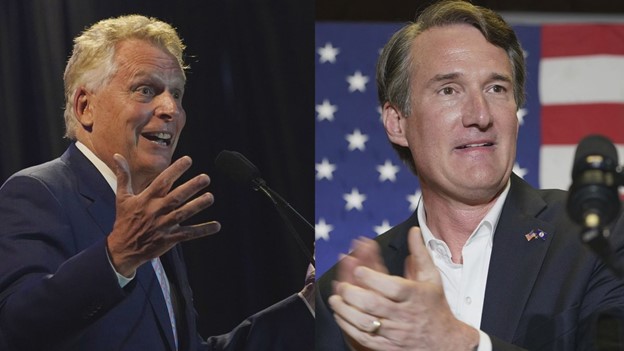
So what caused the Virginia election debacle? And it was a debacle with the loss by Democrats of the offices of Governor, Lieutenant Governor, and Attorney General, and most likely, the majority in the House of Delegates. The State Senate was not in play this year, but with a razor thin 21-19 margin for the Democrats — and the fact that they have their own versions of Joe Manchin, meaning the slim majority is not always reliable — the loss of the Lt. Governor’s race is critical; the current Lt. Governor, Justin Fairfax, cast the deciding vote for Democrats in the Senate 52 times.
At the outset, it is important to analyze the many contributing factors that led to this defeat and to learn from them. Lashing out at only one person or group as the “sole cause” is likely not accurate or helpful, nor is failing to learn and implement new, sounder approaches. Blaming volunteers for not doing enough lets the candidates and the campaign professionals off the hook too easily. They must share the responsibility for this loss and Democrats must take a hard look at where they came up short and make appropriate adjustments for the future.
The Virginia Governor’s race is often described as a “bellwether” for the Congressional mid-terms that take place the following year. However, while it should be viewed as significant data point in assessing the nation’s mood and the issues that are currently in play, in order to develop a cohesive strategy for the mid-terms, the Virginia results do not inevitably, inexorably lead to the same result in the Congressional mid-terms. It is not a cause-and-effect relationship. There is plenty of time to analyze, learn, and adjust – and then implement a better plan next year.
And things can certainly change drastically in one year. After all, who would have thought after Joe Biden’s decisive win last November, followed by a failed Trump insurrection this past January, that a Democratic nominee would struggle in November, much less lose?
Analyzing any loss must begin with the candidate. Was the candidate the right person for the office – and the right person to energize voters during the campaign? Terry McAuliffe undoubtedly was highly qualified to be Governor of Virginia. He held the office as recently as four years ago and did a very good job.
Did he energize the voters and campaign workers? Not as much. As others have pointed out, the Democrats’ propensity for selecting the supposedly “safe” and “electable” candidate is not always a self-fulfilling prophecy, and it is something that needs to be considered in selecting future candidates. Somebody who electrifies the electorate can help get out the vote.
Did the candidate make mistakes in the campaign? Without question. McAuliffe’s statement in the second debate that “I don’t think parents should be telling schools what they should teach” gave Youngkin an opening that he exploited immediately, and McAuliffe’s poll numbers plummeted ever since.
Sure, McAuliffe didn’t really mean that parents should have no role in influencing public school curricula, just as people who say “Defund the Police” don’t really mean “slash police funding to zero and abolish the police” – but it sort of sounds like it, and opponents are thus able to seize on it and sell that as your position. And it is an untenable position.
McAuliffe could — and should — have said something like, “Parents in school districts may have strong – and often conflicting — opinions on school issues, and, after considering the various views, elected school boards and professional educators must make decisions in the overall best interests of the students.” But he didn’t, and Youngkin pounced on it and McAuliffe was forced to explain what he really meant. As the old saw goes, once you are explaining, you are losing.
There has been a lot of discussion of the potential impact on state races of the national gridlock that persisted up until election day, even while Democrats controlled the Executive Branch and both houses of Congress. This concern should not be ignored. The inability of Democrats to pass important legislation on voting rights, infrastructure and more, within the timeframes they themselves set, did not help state Democratic candidates.
Yes, the House finally passed the infrastructure bill last Friday, setting the stage for Biden to sign it into law — but 3 days after the election was simply too late. And Congress and the President may be poised to enact Biden’s groundbreaking Build Back Better plan into law, perhaps as early as next week, but again, that is not soon enough. Having failed to meet expectations – some reasonable and some perhaps overly optimistic – likely had an adverse impact on a significant block of voters.
The fact that the Democratic Governor of New Jersey, who was expected to win in a cakewalk, ran neck and neck with his Republican rival and before eking out a win, lends credence to the possibility that the national stalemate is having ripple effects at the state level.
While Joe Biden’s approval numbers being underwater in Virginia may have hurt McAuliffe and his running mates – it is not an excuse for McAuliffe’s loss. After all, Biden, while increasingly unpopular through election day, was not nearly as toxic as Trump is in Virginia, yet Youngkin overcame Trump’s endorsement.
In fact, Youngkin walked a razor-like tightrope in trying to capitalize on Trump’s support with Virginia MAGA adherents, while distancing himself enough from Trump so he didn’t scare off Independents. McAuliffe, on the other hand, seemed to rely on celebrity Democratic campaign support – from Obama, Biden, and even Kamala Harris – an indication that he was failing on his own.
While McAuliffe had concrete, positive plans for improving Virginia’s jobs outlook, economy, educational system, and environment, much of the publicity around his campaign seemed stuck on a strategy of trying to bait Trump to come to Virginia, so as to paint Youngkin as Trumpkin. Voters may have viewed this as a cynical ploy, too cute by half. Campaign professionals need to do a better job of promoting a positive message that captivates voters, rather than having their inside baseball strategy splashed across the front pages of the papers.
So where do Democrats go from here? If they want to bring out their voters and win over Independents in 2022, they have to give them a reason to go to the polls. Show some real legislative accomplishments. The infrastructure legislation is a start, but voters want to see action on voting rights and on social programs like expanded Medicare; reduced prescription drug costs; enhanced family benefits, including free pre-school, childcare relief, and tax credits; housing assistance; job training; immigration reform; climate initiatives; and ensuring that corporations pay their fair share of taxes.
And by all means, bring Republican criminals to justice, and expose their crimes to the public in ever-increasing detail, but don’t focus only on the evils of Trump and his ilk. Show Americans that voting for Democrats makes a positive difference in their own lives, in terms of job opportunities, social programs that matter to them, and measures that will help enable them to control their own destinies. Then, professional campaign workers and volunteers alike can amplify this message with renewed vigor to get out the vote and keep – or better yet, increase – the Democrats’ control of Congress.
 Brutal Publicist